
Operations
Operations
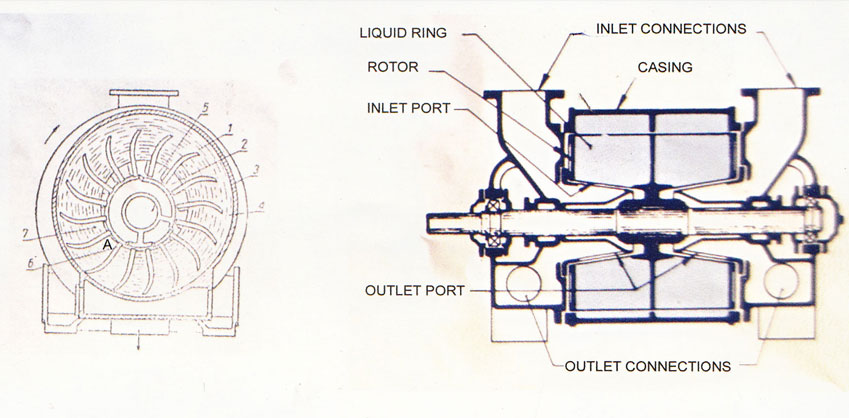
A rotor (1), in balance, revolves without metallic contact, in a circular casing (3) Containing a liquid compressant (usually water) (4). This rotor (1) is a circular casting consisting of a series of blades projecting from a hollow cylindrical hub through which the shaft has been pressed. These blades are shrouded at the sides and form a series of chambers. Note that the curvature of the blades is in the direction of rotation.
Starting at point 'A', the chambers of the rotor are full of water. This water rotates with the rotor, but following the contour of the casing (3), due to centrifugal force. The water (4), which entirely fills the rotor chamber at 'A', recedes into the casing as the rotor advances, until at (S), the rotor chamber is empty. The converging casing forces the water back into the rotor chamber, until at (5), it Is again full.
This cycle occurs once in each revolution. As the water is caused to recede from the rotor chamber at (7), it is replaced by air entering through 'Inlet Port' in conical casting (1), connected with the 'Pump Inlet'. As the rotor turns 360 degrees, and the water is forced by the casing back into the rotor chamber, the air that has filled the chamber Is forced through the 'Discharge Ports' provided in the conical casting (2), to the pump discharge.
Our TTE water ring vacuum pumps have simple construction and its operation is easy